Thursday, August 16, 2012

Magic Rainbow Fountain, Spicy Braised Galbi, and Crazy Horse

With only about a week left in Korea for me, I've been making sure to enjoy all the "To Do" things on my list that are still unchecked.

So this past week, I decided to check out the Magic Rainbow Fountain at Banpo Bridge. Unfortunately, this is not some Disneyland-esque ride. Fortunately, it's still a cool lights-and-water show. Think of the choreographed fountains at the Bellagio in Las Vegas, except off the side of the bridge.

Banpo Bridge on the left, and Namsan Tower (or Seoul Tower) on the right

Here come the waterworks


On a hot night like this one, it's awfully tempting to take an impromptu shower

Thankfully, the weather has cooled down from the record highs of the first half of August. So to celebrate, I wanted to eat some spicy braised galbi. I went to a place in Sinsa called 매운갈비야, which translates to "It's Spicy Galbi".

How spicy is the braised galbi? Well, I had the most basic level of spiciness, and it still caused me to sweat a little. I can't even imagine what Level 4 would taste like!

The front of the establishment

The main dish, which costs 26 000 won ($24) for two people


Lastly, I checked out a jazz club on Garosugil (a trendy boulevard filled with cafes and clothing boutiques) called Crazy Horse. I had gone to a jazz club in Korea before (Club Palm in Hongdae), but it wasn't an entirely pleasant experience as the sax player was too loud and there were too many smokers.

However, I really enjoyed Crazy Horse. I'm not a good judge of jazz music, but the music I heard was enjoyable to listen to, and the ambience of the place was good. Only downside was that the prices were a little expensive (cheapest beer is 8000 won), but it's on Garosugil, so that's to be expected.

The story of how Heineken met Grapefruit Juice

The band

I guess they really don't want fat people in the club...

Garosugil


Tuesday, August 14, 2012

History of a Salaryman: Quite possibly my favourite Korean drama

Don't let this ironically dramatic promo shoot fool you; this show is a zany and irreverent
laugh riot from start to finish

Preface: Korean TV shows (usually referred to as "dramas") are usually 16-20 episodes in length. There are no seasons, so a Korean drama functions more as a very long mini-series, to put it into an American context.

Almost everybody in America these days would agree that right now, television is artistically superior to film. On TV, we have (or had) shows like Breaking Bad, The Wire, Friday Night Lights, Game of Thrones, The Office, Parks and Recreation, and Arrested Development. Meanwhile, on the supposedly more prestigious silver screen, audiences wait for the annual reboot or sequel to the tentpole blockbuster franchise movie.

Hey, this time, Superman is in a WHEELCHAIR! How revolutionary!

Yoo Bang (played by Lee Bum Soo), the unlikely hero of this Korean drama
In Korea, it's the exact opposite. There are almost no shows that penetratingly examine morality, race relations, or social artifice as the top American TV shows do. The best Korean films often push their medium's expectations to the boundaries (for example, the films of Park Chan Wook and Boon Joon Ho), but the best Korean TV is mainly still forgettable fluff starring attractive people doing the same thing that they do in all the other dramas.

I start to watch a lot of Korean dramas, but I rarely finish them. The driving narrative usually peters out by episode 12ish, and the last few episodes are usually just filler as writers are forced to manufacture conflict to prolong the show for just a little bit more.

Yoo Bang's initial nemesis and eventual ally is Yeo Chi (played by Jung Ryeo Won), the hyper-spoiled, tough-as-nails, and foul-mouthed granddaughter of the CEO

It also doesn't help that Korean dramas are often used to try to launch the acting careers of many young pop singers. Most of these people aren't very good at acting, at least at the beginning of their careers.

So I was extremely happy to discover History of a Salaryman, which is only one of 2 Korean dramas that I can honestly say is just as good as, or perhaps better than, the best that the likes of HBO or AMC has to offer (My Name is Kim Samsoon is the other one).

History of a Salaryman follows the story of a man named Yoo Bang (which apparently means "boobs" in Korean), a paycheck-to-paycheck kind of guy on the bottom rung of society. Through sheer circumstance, he gets caught in the middle of high-stakes corporate espionage, and instead of being played for a patsy, he uses his hitherto unacknowledged intelligence, resourcefulness, and leadership skills to emerge as a winner for the first time in his life.

This is how Yoo Bang honestly thinks hedonistic playboy heirs dress like

From what I've described, you may think that Salaryman is a dour morality tale, but it's actually a screwy comedy. The fact that the main character's name is "Boobs" should be a giveaway that the show didn't take itself too seriously. The satirization of Korean corporate culture is very sharp as well, and it manages to be so without becoming preachy.

The show is exciting and addictive because it's unpredictable. There are no clearcut bad guys (at least until the very end) as even the Big Bad Corporations are necessary evils because Yoo Bang dreams of becoming a hotshot CEO himself.

At over 22 hours of total viewing time required, History of a Salaryman is a big commitment, and those who are not already fans of Korean dramas may be unwilling to invest that kind of time in a foreign language show. But if you're curious about what the best of Korean TV has to offer, I can't recommend anything over History of a Salaryman.


Yoo Bang and his boss: The obligatory hero-piggybacks-his-drunk-girlfriend-home trope, with a small twist

PS Anybody who's been convinced by me to give this show a shot can find the torrent files at: http://www.d-addicts.com/forum/torrents.php/images/vss/viewtopic_http://www.d-addicts.com/forum/images/vss/viewtopic_p1294968.htm

PPS The show is shot beautifully, with cinema-like visuals. As more Korean TV stations invest in low-cost, high-quality video cameras like the Canon 5D Mk IIs, Korean dramas will hopefully leave behind the "home video" look that many shows used to have.

Sunday, August 12, 2012

Fun summer things to do in Seoul

Summer in Seoul has been unpredictable weather-wise in my two years here. Last summer was incredibly rainy, whereas this summer has been extremely hot. So if there is a cool and dry day in Seoul, you'd be best off taking advantage of it because most days, you'll be hiding indoors from the unforgiving heat.

Here are some fun things I've done recently around Seoul.

1) Bike Buggy at Olympic Park


I don't know what the popular name of this thing is, so I'll just call it a bike buggy. It comes in 2-person and 4-person models, so make sure you're with at least a friend if you decide to rent one. The rate is about 7000 won for half an hour (which is the equivalent to about $6), or 10 000 won for an hour (around $9). These are weekday rates.

It's a lot of fun exploring Olympic Park in the bike buggy, especially when you go downhill. Just don't turn too fast on the corners because the thing has a high center of gravity and will probably tip over easily. Luckily, this didn't happen to me.

2) Screen Golf


Golf courses are very expensive in Korea, so for most people, screen golf is a much more viable option. For about 20 000 won ($18), you can play a virtual 18 hole course. Everything from clubs and gloves are provided for you, and you can even order food and drinks while you play.

I've never played on a real course before, so I can't say how accurate the virtual experience is. But it's definitely a whole lotta fun, except for when you get on the greens. Putting can be a frustrating experience because the impact detection system doesn't seem to be that accurate.

Or maybe I just suck.

3) Coex Aquarium


The Coex Aquarium doesn't have leaping dolphins or big beluga whales, but it's still a cool place to spend a day, especially a swelteringly hot one in the summer. Admission is 18 000 won for adults (around $16).

My favorite part was the glass tunnel where you could see giant sting rays and shovel-nose sharks swim right above your head.

4) Sunset at Yeouido


It doesn't you a cent (well, other than subway fare) to enjoy the sunset on the banks of the Han River. This photo was taken in the business district of Yeouido, which is also home to the National Assembly building and the annual cherry blossom festival.

5) Eat Patbingsoo


There are few things more fun than eating patbingsoo — ice flakes topped with red beans, fruit, ice cream, mochi, and whatever else — after a hot day of walking around in humid Seoul. Most bowls will cost around 9000 won ($8), and every cafe sells its own version.

Friday, August 10, 2012

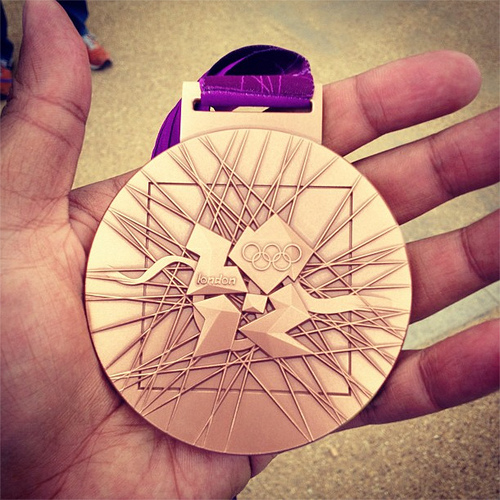
The most golden bronze medal ever

Has a bronze medal ever meant so much?
For a long time, I have wanted this bronze medal for Korea so badly, but I was afraid of getting my hopes up and getting heartbroken. If Korea failed to medal this year, then the only likely remaining chance for many of these players to earn military exemption would be at the Asian Games in 2014.

Now was our glorious chance, but would we be able to seize it?

There's a whole lotta historical, political, and cultural reasons why a Korea victory over Japan means so much to people, but I'll try to explain in pure footballing terms why it was of such utmost importance for Korea to win the bronze medal.

Of course there's military exemption, but that's obvious and I've written about that before. So what else was at stake?

Quite simply, what was at stake was genuine optimism for Korean football amidst turbulent changes and an intensifying rivalry with Japan.

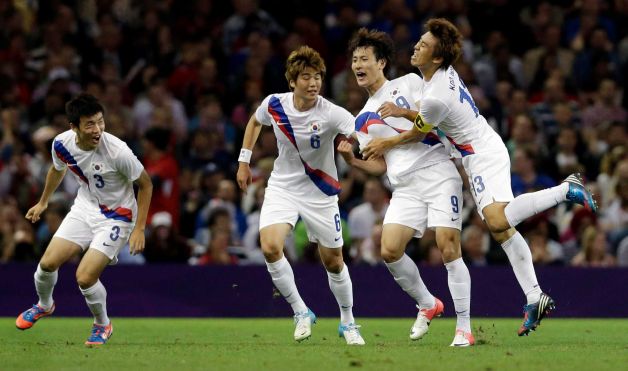
Park Chu Young, Koo Ja Cheol, and Ki Sung Yueng
will now be able to lead the new generation of
Korean footballers for the next 10 years,
unencumbered by military duties
Korea did well in the 2010 World Cup when they advanced to the Round of 16 and lost to eventual 4th place finishers Uruguay. But afterwards, the team grew stagnant while its closest rivals, Japan, began to impressively ascend to new heights. This was bitterly highlighted in Japan's two most recent victories against Korea: a shootout victory in the 2011 Asian Cup, and a dominant 3-0 victory in the last Haniljeon (what we call a Korea-Japan derby match).

Korea's road to the World Cup had also become rocky. A shock loss last year to Lebanon led to the firing of manager Cho Kwang Rae, and the search for his successor was less than organized. Eventually, Choi Kang Hee (a safe and logical pick) was chosen as the new manager, and he led the team to a series of unconvincing wins over bad-to-mediocre Middle Eastern sides.

With the retirement of legendary veterans like Park Ji Sung and Lee Young Pyo, Korea had a serious leadership vacuum and an uncertain future. Meanwhile, the fact that Japan with its superstar players (like Shinji Kagawa, Keisuke Honda, and Yuto Nagatomo) was being recognized as an upcoming footballing power just made everything more painful for Korean football fans.

If they could do it, why couldn't we?

That's why this Olympics meant so much to us. It was the story of a young team that saw a new leadership core emerge in the midfield partnership of Ki Sung Yueng and Koo Ja Cheol. It also saw the well-disciplined solidification of what had been the weakest part of the Korean team for a long time: its defense. And it was a testing ground for manager Hong Myung Bo, who promised to be the kind of charismatic leader that Korean football hadn't seen since the likes of the canonized Guus Hiddink.

Park Chu Young redeemed himself after an intensely difficult year that saw him bafflingly ignored
at Arsenal and vilified as unpatriotic for obtaining military service deferment through his ties to Monaco.
Park scored the crucial first goal against Japan and assisted on the backbreaking second.

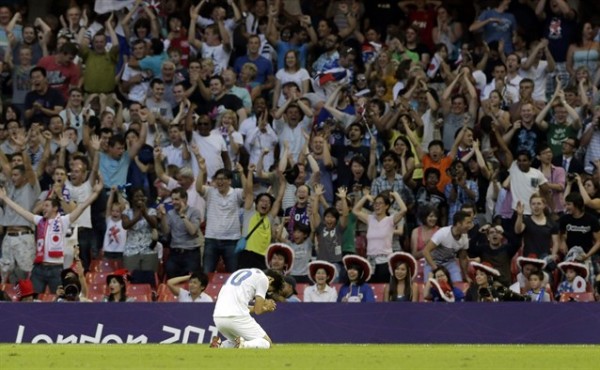
Well, now that Korea has accomplished the seemingly impossible dream of medalling in football in these Olympics, I'm surprised that I'm not more ecstatic. I was floating when Korea beat Switzerland, and I was in rapturous ecstasy when we beat Great Britain. But I feel so calm now that we've beaten Japan. It's almost as if I felt that there was no possible way that the universe would let us lose after we had come this close. I dreaded to think about how I would cope with a loss to Japan, but I was never that afraid.

Well, it's now the sweet end of a long journey, and I probably won't write about Korean football much anymore. I can't emphasize how monumental of a turning point this is, as an entire generation of perhaps the most promising bunch of young Korean players has now been freed of debilitating military service. This victory over Japan will go down as one of the most famous wins in the team's history.

Hong Myung Bo: The New King of Korea

London 2012. Best Olympics ever.


Thursday, August 9, 2012

Shoutout to one of my favourite Korean shows, "Running Man"


"Running Man" is a popular show in Korea, and one I try to catch as often as possible. It can best be described as a weekly comedic reality/game show in which a regular cast is randomly split up into multiple teams and given various missions which they must complete in order to win. But the show is "pointless" in the sense that it doesn't really matter who actually wins in the end, because the show's mainly a comedy as opposed to a competition.

Gary piggybacking guest star Shin Se Kyung across a foam bridge floating on a swimming pool
So every week, the same hapless fools in the cast are tasked with completing a series of silly missions that are deliberately designed to test their patience, endurance, and/or dignity. Those missions are nothing too extreme, like eating animal guts; rather, they're more along the lines of forcing a team to dance in public until their heart-rate reaches a certain point.

Yoo Jae Suk, aka "The Nation's MC"
The cast members are made up of somewhat famous celebrities from music and TV/film, and though "Running Man" is supposed to be a reality show in which all the cast members use their real names, they still adopt well-defined personalities. For example, there's the Dorky Loser who falls in unrequited love with women too easily (Ha-Ha), the Jock Bully who dominates the physical challenges and pushes everybody else around (Kim Jong Kook), the Meek Beanpole whom everybody picks on (Lee Kwang Soo), and the Useless Older Guy whom nobody ever wants on their team (Ji Suk Jin).

Moderating and leading this group as MC is Yoo Jae Suk, who is kind of like the Korean equivalent of, say, Johnny Carson. Or Wayne Brady. I dunno, just think of any clean and charismatic comedian who is impossible to hate.

Lee Kwang Soo and guest star Jiyoung (KARA) on the Great Wall of China
While there are a few shows that are similar to "Running Man", namely "2 Days 1 Night" and "Infinity Challenge", a couple of major things set the show apart from its competitors. Firstly, the missions in Running Man are designed to take place in urban environments, and because of that, the show often functions as almost like a fun visual travelogue of Seoul and other Korean cities. And in special episodes, the show even goes abroad to such places as Bangkok, Hong Kong, and Beijing.

Secondly, the show is unique in that it has a regular female cast member in Song Ji Hyo. The funny thing about this is that while Song Ji Hyo the Actress is one who usually plays the attractive woman roles, Song Ji Hyo the Running Man Cast Member is treated just like one of the guys. Most of the other cast members don't even see her as a woman, which annoys her despite the fact that she'd just as quickly reject any advances from them. This sets up tonnes of endlessly exploitable comedic situations with light sexual tension that's missing from the all-male casts of the other shows.

Turns out that PJS has a personality
when he doesn't have to be a
typical cliche-spewing jock
Lastly, my favourite episodes tend to be the ones that have guest stars in them. Even if it's an illusion, it makes the viewer feel as if he or she is getting to see famous stars in a more natural environment, as opposed to a highly pre-planned interview set or press conference. Recently, soccer star Park Ji Sung guest starred for a couple of episodes and really had a chance to show off his personality. I, like many others, had always thought of him as a kind of athletic robot, but if the show is even somewhat accurate, Ji Sung is actually a pretty cool guy who'd be great to hang out with.

That's really the appeal of the show for me. Often, it just feels like you're watching a bunch of buddies hang out, ragging on each other and just having a blast. I wish I could join them sometimes.


Tuesday, August 7, 2012

Korea's football team should be exempt from military service, no matter what

How many Olympic sports can sell out a 70 000 capacity stadium?

Preface: Korean male athletes are exempt from military service if they win an Olympic medal. Otherwise, they must serve for 2 years before the age of 29 (which conveniently coincides with the prime of a footballer's career).

Not all Olympic sports are equal. Some medals are much harder to obtain than others.

For example, football. Football is different. It just is.

Olympic football is a 2-week tournament that begins before the Opening Ceremonies and ends with the gold medal match on the eve of the Closing Ceremonies. Any team that wins a medal will have played 6 hard-fought matches, each of which were at least 90 minutes long.

It's quite ludicrous how all that effort only adds up to one medal for a team, whereas a swimmer can rack up multiple golds in just a few days.

There are already certain sports that give out 2 bronze medals, such as Judo, Tae Kwon Do, Wrestling, and Boxing. The difference between third place and fourth place is completely arbitrary, and no different than, say, distinguishing between fifth and sixth place. It's just our culture's bias towards the number 3.

I'm not saying this because I fear that Korea will finish 4th. I think they'll play Brazil very hard, and if they don't beat them, they are certainly more than capable of beating Japan or Mexico for the bronze.

But if after all this, Korea ends up losing the next couple of matches to finish 4th and, thus, become ineligible for military service exemption, then I'll be absolutely gutted. And so will an entire country. It would be the absolute cruelest ending to what has been the most rousing Korean football experience since the 2002 World Cup.

People are notorious for wanting to have contradictory things. They want low taxes but lots of government services. Men want to sleep around but have chaste women for wives. And (some) Koreans want football players to be treated like everybody else, but they also want to keep up with the rest of the world in the sport, especially Japan.

Korea's the only football country in the world that handicaps itself by forcing the early retirement of its players. If its ambitions are modest, then so be it. But it's not. Korea dreams of becoming a very good footballing nation. It can't do that when every Korean footballer's career basically ends at the young age of 27.

Perhaps there are lots of bitter citizens who don't want superstar footballers to get opportunities that most Korean men don't have. But if so, then I hope they're also perfectly okay with being merely a regional power, and falling more and more behind Japan.

Korea's already made national history by progressing to the semis in Olympic football. If they beat Brazil, then everything I said won't matter, at least not for another generation. But what if they don't? Is there that big a difference between 3rd and 4th place? Is the government really going to stunt the careers of perhaps the most promising generation of Korean footballers ever just because of a totally arbitrary human predilection for the number 3?

Ah, just go and beat Brazil.


Sunday, August 5, 2012

Korea beats GB in epic football QF shootout

Ji Dong Won (9) is swarmed by teammates after he opens the scoring against GB 

London 2012 has been a bipolar Olympics for Korea, as inexplicable judges' decisions against the country have soured the elation that has followed its better-than-expected medal tally so far.

First, there was the nonsensical disqualification (and reinstatement hours later) of star swimmer Park Tae Hwan in the semi-finals of his signature event, the 400m freestyle.

Then there was the inexplicable reversal of decision in a judo match between Korean judoka Cho Jun Ho and his Japanese opponent, in which Cho was given the victory by all 3 judges until some suit intervened and forced the awarding of victory to the Japanese judoka.

And perhaps most infamously, Korean fencer Shin Ah Ram should've made it to the finals of the women's epee, but was denied a victory when the judges forgot how to tell time and gave her German opponent almost 4 seconds when there was only 1 more second left in the round.

Wait, what's Korea doing up there?! Isn't that the Axis of Evil country with all the mail order brides?


Also, despite the fact that Korea has been in the top 4 of the medal tables for the first half of these Olympics, NBC has mentioned them exactly ZERO times in its coverage: http://deadspin.com/5931343/nbcmetrics-through-wednesday-south-korea-had-14-medals-and-nbc-had-never-mentioned-it-in-primetime 

All these events have stoked pervasive feelings among Koreans that our country is still not given due respect on the world stage despite our status as an OECD nation and a technological hub of the world. There are many resentful Koreans who feel that since the West fulfills its "Asian Appreciation Quota" with China and Japan (yay, chow mein and samurai!), Korea is still seen as a developing country that is mainly the source of dogmeat jokes and war brides.

Daniel Sturridge becomes the latest in a proud
lineage of Britons who've succumbed to
pressure during PKs
So it was unimaginably sweet when on 4 Aug 2012, the Korean men's football team outplayed and defeated the GB team on GB's home turf, especially since GB had been gifted 2 very soft penalty kicks in a dizzying span of four minutes in the first half (which Korea had dominated). Luckily for Korea, their goalkeeper Jung Sung Ryong saved 1 out of the 2 penalties, thus effectively saving the match for them.

If Korea had felt slighted by the Games in general thus far, then there was no better way to exact revenge than to knock out the host country in its favourite sport on its home field.

Some sour grapes people may dismiss the event altogether, saying that nobody cares about Olympics football. But Millennium Stadium in Cardiff was packed that night, and the look of devastation on the British players (especially Daniel Sturridge, who missed the crucial shot during PKs) should tell you that both Korea and GB, and their supporters, wanted to win badly tonight.

This will likely be the last GB football team ever assembled because there's no way in hell that Wales and Scotland will tolerate playing under the Union Jack and singing "God Save The Queen" as its team anthem for anything other than a Great Britain-hosted Olympics.

So the history books will indicate that the last ever incarnation of a GB football team played its final match in front of a raucous home crowd in Cardiff.

Ki Sung Yueng celebrates burying his decisive PK
And they lost to the Koreans.

Will people take more notice of Korea next time?

PS When KSY won the match for Korea with his PK, I started jumping and screaming so much that I slipped on the straw mat on the hardwood floor and landed awkwardly. But I was all right!
UA-49948643-1