Showing posts with label culture. Show all posts

Thursday, February 13, 2014

A Prescription for Cinematic Amnesia (Movies I've Watched Recently), Pt. II

The Lover (L'Amant)


Some movies are borderline porn. Like, if you were having nice coffee chat with an alien and were trying to explain to it the difference between something like Pirates (aka that really high budget porn version of Pirates of the Carribean... not that I've ever seen it) and some very sexually explicit movies like The Lover (or Lust, Caution or Unfaithful or Last Tango in Paris), it may be really difficult to articulate the difference, even if you know that there is a difference.

I'm not saying this as something derogatory. In fact, Lust, Caution is one of my favourite films, and I enjoyed The Lover as well. The story here is very simple and the characters don't even have names. The Girl is a French teenager in colonial Vietnam whose family has lost everything financially, but they still cling to some level of social status due to their Frenchness. The Chinaman (seriously, that's his character's name in the credits) is a wealthy ethnic Chinese living in Vietnam. He's what you'd have called a "dandy" in the 19th century: a young man with no particular skills except in traveling and spending his family's money.

What's most interesting about this movie is the fact that while The Chinaman is significantly older and wealthier than The Girl, he is still beneath her in some way because she is French and he is Chinese. In colonial Vietnam, that makes a big difference and they both know it. In one telling scene, she asks him if he's ever been with a French girl before (since he was recently in Paris). He says only prostitutes, because that's all he's allowed to "have." So the movie is more complex than simply a story about an older rich guy taking advantage of a helpless teenage girl, but rather, how two people navigate a crumbling and shifting society using the advantages given to them.

Definitely don't watch this with your parents in the same room


2014 Oscar-Nominated Animated Shorts


It's not only sad to think of all the movies you'll never get to see, but it's even more of a downer to think of all the documentaries, shorts, and animated shorts that you'll never watch either. So I took the chance recently to go to a showing of the 2014 Oscar-Nominated Animated Shorts. The shorts are very diverse, ranging in tones from sarcastic, creepy, charming, and cute. There's one set in a steampunk robot city where a citizen adopts a dog (Mr. Hublot), one about a witch and a cat who make friends while flying across the land (Room On The Broom), and one where two umbrellas fall in love (The Blue Umbrella).

My favourite was Feral because it was spooky and heartbreaking. It's about a wild wolf-child and the artwork is unique in a nightmarish way, reminiscent of a Francis Bacon painting.

Mmm, Bacony


The Squid and the Whale

Growing up, I always wished my parents were the type to try to relate to me and talk to me as if we were pals. But then I watch movies like this and thank god that they weren't. Yikes, could you imagine having the Jeff Daniels character as your dad? He's the type who'd sneer at you if you talked to him about some girl who didn't reciprocate your feelings, then go on to talk about all the hot chicks he had, or could've had, when he was your age. All while throwing around quotes from Saul Bellow and William Faulkner.

The Squid and the Whale is a movie about a divorce and how two sons (the elder one played by Jesse Eisenberg) deal with it. The parents are super-educated members (or wannabe members) of the literati who live in Park Slope and discuss the merits of A Tale of Two Cities at the dinner table. This isn't exactly the most relatable demographic in the world, but most people will be able to identify with the divided loyalties that the two brothers face. I didn't like Noah Baumbach's Kicking and Screaming, but this movie was better. Even though it was very autobiographical, it felt less like an exercise in self-obsession ("Look at me and my over-privileged wannabe literary friends because we matter!") and more honest and painful because hey, we've all known what it's like to love, hate, and be disappointed by our parents.

The corduroy signifies his "down with it-ness"


Mitt

I've always thought that Mitt Romney was a good enough guy who was possibly one of those people who just wasn't meant to be a political leader. He may be a management whiz, loving father, and valuable member of his church community, but those things don't make you a good presidential candidate. Remember that it wasn't just Democrats who loathed him. It was his Republican rivals like Rick Perry, John McCain, and Rick Santorum who just despised him on a personal level. And it was London Mayor Boris Johnson who joined in on the anti-Mitt fun (after Romney's ill-advised comments on London's preparations for the Olympics) when he had no real dog in the race. There's just something about the guy.

Mitt rescues his image the best way possible, in my opinion. Romney is not inspiring because he doesn't have a greater vision other than the fact that he'd be great for America because he made a lot of money at Bain Capital. But that doesn't make him a bad person, and it's nice to see him surrounded by those who love him, as opposed to those who would love to see him fail (aka many fellow ambitious Republicans).

What most impressed me about Romney was how self-aware he is. Even back in 2006 or so, he's aware of his own weaknesses in terms of public perception, as he dubs himself the "Flippin' Mormon." Even after his knockout first debate performance that revitalized his post-47% presidential campaign, he calmly tells everyone that first debates are always won by the challengers and that President Obama will be way better next time.


Linsanity


I'm kind of a Jeremy Lin fanatic. Ever since he joined the Houston Rockets, I've watched almost all of their games, and as a result, I could tell you that in his first month or so as a Rocket, sportswriters were legitimately wondering if he and Harden could be the best backcourt in the league. But then he went into a funk, mainly due to the knee injury that sidelined him for the Knicks' playoff series against the Heat. He hit his stride after the all-star break, only to play very poorly (like the rest of the team) in Game 1 against the Oklahoma City Thunder in the first round of the playoffs. Then he got injured in Game 2, allowing Beverley to come in and play well. Then this season, Beverley was named the starter because he is tenacious defender and a good 3pt shooter, and Lin's skills were seen to be somewhat redundant when pared with James Harden's. Lin adjusted to the 6th Man role pretty well and even had some monster games that exceeded anything he did in his Linsanity run. He had a very bad January, however, the lowest of which came against a pair of losses against the Memphis Grizzlies. But then Harden got injured and Lin was thrust back into a primary role, and he found his groove again. Recently, he got his first triple double and is now back to balling as a 6th Man.

But Linsanity is about the beginning. For someone like me who's watched all the highlights and interviews on Youtube many times, there's nothing too enlightening about this documentary, but I do appreciate the greater social commentary provided by his high school and college coaches. It's also quite harrowing to listen to Lin and his family's account of the days leading up to that first breakout game against the New Jersey Nets, and how that was almost certainly his last chance to make an impression before he got cut permanently from the NBA.

It was outplay Deron Williams or go home, permanently

Over at Deadspin, they have this great series on the history of Black QBs in the NFL. I've always thought that Jeremy Lin was a natural successor to someone like Warren Moon or Doug Williams (former was the first Black QB to be inducted into the Hall of Fame, and the latter was the first Black QB to win the Superbowl). Nowadays, it's pretty common to see Black QBs. Russell Wilson just won the Superbowl and it's as though people forgot that he wasn't some White dude who grew up in Idaho. Many of the next gen young QBs are also Black: Cam Newton, RG3, Colin Kaepernick, and the aforementioned Russell Wilson. In fact, if you're a racist fan, you're pretty much having to pin all your hopes on Andrew Luck once the Manning-Brady-Brees-Rodgers group fades away.

In those Deadspin articles, they talk about older Black men who pinned so much of their hopes on the likes of Warren Moon and Doug Williams because they help inspire others, especially those of their own race, to confidently discard stereotypes that were so ingrained in our society that many people, even Black people, sort of believed in them. Because in the end, it's not about being quarterback or point guard; it's about being told that you're inherently incapable of doing something because of your race, and then making a fool out of anyone who told you that.

Anyway, very enjoyable and uplifting, especially if you haven't rewatched the highlights to death as I have. The interesting thing is that you could easily make another documentary about that weird offseason when the Knicks let him go, and that topsy-turvy first season in Houston when everybody expected him to fall flat on his face.

Monday, February 3, 2014

Things That Prevent Me From Being A "True Korean"

As a disclaimer, I realize that there isn't, nor should there be, a rigid definition of a "True Korean." In this case, I'm just using it to denote an identity that is formed by a series of common experiences shared by those who grow up in Korea. 

The thing you find out when you live for some time in your ancestral country is that while you may have felt very Korean (or Chinese or Mexican or Polish or whatever) back home where you were a minority of some kind, you're actually not that Korean when compared to people who were born and raised in that country. How could you be after having spent your entire life in another country and culture?

It's like that time in The Sopranos when Paulie goes to Italy for the first time. After a lifetime of complaining about America and how they're stealing all of Italy's precious gifts to the world (like "expresso"), he thinks he's going to finally be at home in Italy. But he sticks out like a sore thumb because he is, after all, a New Jersey guy more than anything else.

I think I'm pretty Korean for someone who, until recently, didn't spend any significant time in Korea outside of vacations. But there are certain things that, in my opinion, keep me "different."

1) I've never served in the military and won't ever have to

Growing up, every Korean male citizen knows that he has to devote 21-24 months of his life to mandatory military service, usually served sometime in his 20s. Frankly speaking, not all time periods in one's life are created equal, and your 20s are probably the years that you least want to sacrifice for something that probably seems to many as the world's longest hazing ritual.

By sole virtue of having been born overseas, I've never had to worry about this issue. But if I had, I could see how it would've affected my entire outlook on my young adulthood. There'd be this massive two-year black hole where I'd have to put everything on hold—whether it be studies, career development, creative growth, relationships—for... what exactly?

Of course, going through such things tend to create bonds between people, which is why I feel that I'll always be something of an outsider in Korean society.

Um, looks like fun! Buuuuuut I think I'll take a rain check

2) I've never gone to school in Korea

Korean schools are notoriously competitive and stress-inducing. Having never spent a single minute inside of one, I can't tell how much of it is true and how much of it is media sensationalism. But I remember my 2nd and 3rd grade classes mainly consisted of my teacher playing the piano as we sang along to The Sound of Music. A major part of 7th grade was a lip sync contest where, as part of our music curriculum, we dressed up like The Beach Boys or James Brown and performed in front of the school.

I'm guessing that most Korean schools don't have time for stuff like that. And this is not even considering the after-school schools ("hakwons") that most kids go to. Factoring that in, I'm even further removed from the typical Korean upbringing.

The closest I've come to Korean education is watching "School 2013"

3) I can't swear in Korean

A major part of true fluency in a language is being able to speak in idioms and slang. Paradoxically, a true speaker of a language should use it in all sorts of incorrect ways. Swearing is part of this familiarity with a language. If you ever meet someone who can't swear in English, chances are that he or she learned it from a book while listening to NPR and reading Dickens.

I can't swear at all in Korean, mostly because I've mainly used it to speak with parents and grandparents. It's even difficult for me to express real anger in Korean. At best, I can only muster up a kind of exasperated annoyance.

Can you imagine not being able to swear, or even express anger, when talking among your friends? Some people's relationships with their friends almost entirely consist of swearing and griping about various things. I like interacting in Korean when I can, but it's still a challenge because it's harder to naturally convey what I'm thinking and feeling.

My inability to swear in Korean would be severely restricting in times like this

4) My internet nationality is American

We spend so much of our time nowadays on the internet, which is a globe onto itself. And the internet could be divided into countries as well. As I am most comfortable with English as my reading language, I almost exclusively stick to English sites. But entire online continents exist in other languages too. Korean internet culture is extremely vibrant, though some would say viciously so. Yet because my reading level in Korean is not that great, I don't have easy access to this world. I am ignorant as to how people my age interact on Korean internet forums and websites, and thus, I'm not part of that online culture.


5) I don't understand inter-Asian rivalries

I remember when guys like Ichiro and Yao Ming broke into the MLB and NBA, respectively. I instantly became their fans because it was rare enough to see an Asian celebrity in America, much less an athlete. Nowadays, it's much more common, but when I was younger, that wasn't the case.

Ichiro and Yao were from Asia. So was I (ancestrally speaking). Therefore, I felt a strong connection with them.

But many Koreans in Korea probably wouldn't have, especially with Ichiro because he was Japanese and there's a lot of recent historical misgivings between Korea and Japan (plus, he's kind of a cocky SOB and talked smack about Korea in one of the World Baseball Classics...). Koreans don't necessarily define themselves as "Asian" because they're not a racial minority in their own country, so they don't have to adopt an inclusive category just to be visible and have some influence.

Gotta give him respect

But despite all this, I'm obviously more Korean than I'm not, and even though I may not have had the same experiences as someone who grew up in Seoul, my own experiences as a gyopo have something to offer to the collective Korean identity.


Friday, October 18, 2013

Watching Disney in Foreign Languages on Youtube

One of the things that I've always wanted to know is how English and Korean sound to people who don't speak them. It's one of those things that are infinitely fascinating because unless I get amnesia or something to lose my language capabilities, it's something that I can never know.

I think it was in my attempt to answer that question that I, sometime early in freshman year (or perhaps senior year of high school), discovered that there was a treasure trove of Disney musical sequences in foreign languages on Youtube. Ever since then, I've been listening to these things over and over again to the point where I used Youtube converter websites to download them as MP3s so I could listen to them on the go.

I'm not quite sure what makes them so captivating. I think the biggest thing is the pleasure you get from mixing something so familiar with something so indecipherable. If you sat there and listened to a conversation in, say, Turkish, it would be interesting but also frustratingly incomprehensible.

But put the same language in the magic carpet ride sequence from Aladdin, and whatever language is being sung, it becomes immediately understandable because we all know the lyrics and context. That also allows us (or least me) to enjoy the musicality of the language itself. Yeah, it's all foreign to me, but there's a big difference in the ways that Icelandic is impenetrable from Mandarin, and I can relax and try to appreciate those qualities.

It just makes me sad that out of all the languages in the world, I'll probably only end up knowing two of them.

Russian: Part of Your World Reprise from The Little Mermaid


Korean: God Bless The Outcasts from The Hunchback of Notre Dame


Arabic: Beauty and the Beast from Beauty and the Beast


French: Reflection from Mulan


Zulu: I Just Can't Wait To Be King from The Lion King


Portuguese: A Whole New World from Aladdin


Thai: Once Upon A Dream from The Sleeping Beauty


Italian: I Won't Say I'm In Love from Hercules


Hindi: Kiss the Girl from The Little Mermaid


Turkish: Colors of the Wind from Pocahontas


Icelandic: Part of Your World from The Little Mermaid


German: Go the Distance from Hercules


Japanese: Son of Man from Tarzan


Romanian: Something There from Beauty and the Beast


Swedish: One Jump Ahead Reprise from Aladdin


Cantonese: So This Is Love from Cinderella


Friday, October 4, 2013

The Snowpiercer Paradox, Part 1: If Korean Audiences Can Accept A White Protagonist, Then Why Can't Americans Accept An Asian One?


I've been anticipating Gravity for a while, and now it's been released to swooning reviews that compare it to 2001: A Space Oddysey. Can't wait to go see it in IMAX. But thinking of this movie reminded me of the other critical super mega smash of the year, Snowpiercer, which of course we won't be able to see until god knows when and in what mutilated condition thanks to Harvey Weinstein.

And this got me thinking...

Snowpiercer is an awesome Korean movie that has broken box office records in Korea, in addition to getting rave reviews from critics all around the world. The interesting thing is that while it's a Korean-made film, the hero is Chris Evans and most of the cast (Tilda Swinton, John Hurt, Ed Harris, Jamie Bell, and Alison Pill) is White, while Octavia Spencer is Black. There are only 2 significant Korean actors: Song Kang Ho and Ah Sung Ko. And still, Koreans came out in droves to see this movie.

Tilda Swinton too wants to give Harvey Weinstein a big "Fuck you!" for wanting to cut 20 minutes from the
American version of Snowpiercer

Yet the reverse would never happen in America, or at least, it'd never be allowed to happen in America. In countries such as Korea, China, India, Nigeria, and Brazil, movies starring White people regularly set box office records and people of those countries have no problem watching foreign-looking actors such as Matt Damon or Brad Pitt star in movies about cultures they're not entirely familiar with in a language that they may not fully understand.

Let's take a look at the American all-time box office, shall we? I took a glance, and I had to go down all the way to #43 to find a movie that starred a non-White person, and that depends entirely on how you choose to classify the notoriously racially ambiguous Vin Diesel (the movie is Fast and Furious 6, by the way).

On the bright side, American audiences show a surprising high level of empathy and tolerance for bipedal blue cats (Avatar), anthropomorphic playthings (Toy Story 3), hairy-footed halflings (The Lord of the Rings franchise), animated lions (The Lion King), bugle-eared green ogres (Shrek), and waddling bug-eyed aliens (E.T.).

So great news, struggling minority actors! Though the timetable on your acceptance as protagonists may take a while, perhaps you can be reincarnated as a cartoon animal or a Martian, and thereby be instantly accepted by American audiences as being worthy of empathy because you're not so strange and foreign as an African American or an Asian American.

Pretty sad that this is Hollywood's most successful movie with a protagonist of African descent

But it's one thing to be totally ignored. It's another to be selectively ignored in the process of cultural re-appropriation. This happens a lot in Hollywood with regards to Asian culture. The message I get from them is that Asian culture is awesome! Our food is great, our history is fascinating, our architecture is inspiring, our myths are cool, and our philosophies are enlightened.

But our people? Meh. Asia is great, except for its people. Especially the men, since the women can be beautifully exotic in a way and fulfill a pre-feminist void that's existed in the West ever since the pesky 1960s and Hillary Clinton rolled along.

Don't believe me? Just look at this summer alone. Two movies were either greatly inspired by or took place in Asia: Pacific Rim and The Wolverine. The former was clearly based on Japanese manga like Mobile Suit Gundam Wing, and even its title pays tribute to the region from where it drew its ideas. And the latter mostly takes place in Japan and has a number of Japanese supporting characters. But are the movies centered around Asian characters? Nope. Pacific Rim has Rinko Kikuchi in a supporting role, and The Wolverine has some Japanese characters that orbit around Hugh Jackman's heroism. Unsurprisingly, the two highest billed Asian actors are both female.

Jeff Yang of the Wall Street Journal summed the movie up pretty well in a Facebook post:

Preach
Fantastical cultural self-insertion isn't inherently wrong. If there were a Korean movie that involved a time-travelling Korean dude who landed in King Richard's court, helped prevent the Crusades, and got engaged to an earl's daughter, then that's the stuff that cinematic imagination is made of. After all, aren't movies supposed to depict the unlikely or the impossible?

The problem with Hollywood is that it happens ALL. THE. TIME. Here are some recent examples of movies in which Asian characters were replaced with White ones.

Cloud Atlas (2012)
The King of Fighters (2010)
The Last Airbender (2010)
Dragonball: Evolution (2009)
21 (2008)

Yellowface in "Cloud Atlas". Yeah, I know.

B-b-b-but.. It's about box office draw! Well, argument won, I guess. Jim Sturgess, Justin Chatwin, Jackson Rathbone, Sean Faris, and Jim Sturgess again (seriously, what's up with this guy?)... Can't argue with that kind of megawatt, household name, Q-rating-busting starpower.

And then there are the other types of cases in which a largely Asian story and setting is used to tell the far more important tale of the one White dude in the midst of it all. I'm looking at you, The Last Samurai. The ridiculousness of this movie has been well-documented, perhaps immortalized by Paul Mooney's little skit, but let me rehash your memory: American Civil War drunkard Tom Cruise goes to Japan, kills a master samurai which makes his widow fall in love with him for some reason (Seduction 101, fellas: Murdering a woman's spouse is like writing her 20 sonnets), becomes 2nd best samurai in Japan in a matter of weeks/months, and becomes lone survivor of an epic slaughter so that he can teach the Japanese on how to really be Japanese.


Then there's the gem, Come See The Paradise, which was made in 1990 and is the only major movie about the Japanese Internment. Naturally, such a traumatic, seismic, and under-explored event in Asian American history is the perfect opportunity to tell the love story between some White dude and Tamlyn Tomita.

But the most hilarious example has to be the Canadian production, Iron Road (2008). It manages to take the construction of the Canadian Pacific Railway, perhaps one of the biggest sausagefests in history, and somehow make it all about yet another love story between a White dude and an Asian woman.

Feel the romance

Sensing a pattern here?

And in case you think that this is all part of the shameful past that's been relegated to the dustbin ever since the "post-racial" Obama era, let's take a look ahead. Smell that? It's the waft of more Hollywood bullshit. But that's going to be in Part 2.


Sunday, September 15, 2013

The Ambiguous Morals of the Julie Chen Story


This news was, at first, so blah to me. Does the headline "Minority person felt unaccepted because of her racially distinct features" strike anybody as shocking? Seriously, this shit is everywhere from the moment you become awake to the world around you. Some groups obsess over the lightness of their skin, while others worry about "good" and "bad" hair. We can't get over our eyes. This is what happens when you're bombarded, upon birth, with nursery rhymes, fairy tales, historical accounts (many of which might as well be fairy tales), TV shows, movies, books, poems, plays, musicals, toys, cartoons, and advertisements that feature people who don't look like you.

But still, this Julie Chen story does raise the potential for a much-needed discussion.

Let me just say first that I think those who moralize about plastic surgery are at best, clueless, and at worst, knowingly hypocritical. We live in a society where looks matter, and that's never going to change. So if you condemn plastic surgery, then you also have to actually condemn superficiality and then practice what you preach. There's little worse than somebody who chastises those who seek plastic surgery, but then refuses to date anyone who is less than very attractive. What they're really saying is that they're so shallow that they not only prize beauty above all else, but only NATURAL beauty. Kind of like how diamonds are more valuable than cubic zirconia. And because only natural beauty gets passed down to your children, and beautiful children are more worthy of love. That's what it's all about, right?

Ahh, so cute! You're worthy of my care and attention.

But plastic surgery becomes a different issue when racial issues get involved because then, it's no longer just about yourself. It's about how you perceive your family, your community, your ancestral country, and even possibly your future children. It also reinforces the massive feedback loop that constantly blares out that if you're not White, then you're just somehow not good enough. Race is different from almost everything else because it's so fundamentally unalterable. If you reject someone's race, you're not only rejecting them; you're also rejecting their ancestors, their living family members, and their future children.

Whether Julie Chen was weak for giving into her network's demands is not very important. It happened a long time ago and there's nothing we can do to change it. Jackie Chan also got a similar procedure done very early in his career, and many Asian celebrities in Asia undergo plastic surgery (just like how many American celebrities do in hopes of furthering their careers). It's the sad nature of the entertainment/media industry.

Still, let's not lose sight of the fact that Julie Chen has been ultimately rewarded for her choice to acquiesce to the racist demands made on her. And it wasn't just the plastic surgery. She also married a much older White man who just happened to be an executive at the network that now employs her.  I appreciate the fact that she's speaking out about this after all this time, but the fact is that she is doing so after reaping the benefits of falling in line with the unfair status quo. As I said before though, it's pointless to judge her, and we can't all be confident that we'd have defiantly diverted our dreams in the name of racial pride had we been in her shoes.

What's actually important is the lesson we derive from all this is. Have things really changed since Julie Chen's days? We still live in a world where Asians are underrepresented in the media because studios and networks still think that "mainstream" (aka White) audiences won't be able to relate to Asian protagonists. Our "weird" eyes probably have something to do with that. And we still live in a world where associating with White people generally boosts your social status and bestows upon you that elusive cultural capital that you wouldn't be able to get in your ethnic social circles.

Because the story of 230 000 dead Asians isn't quite as tragic as the difficulties of a wealthy, blonde family

We shouldn't harshly criticize Julie Chen, but we shouldn't be as reserved on those who would seek to emulate her in this day and age, and those who see in her a well-defined path to "success". I'm sorry, but you can't have it both ways. You can't conform in almost every way possible to please a racist society, benefit hugely from doing so, then speak up way later when it's safe to do so and proclaim yourself to be a brave crusader. Not that Julie Chen has held herself up as some kind of equal justice warrior, but the media has largely made this into a personal interest story that celebrates her ultimate success despite her initial struggles, instead of a critical examination of the forces that compelled her to do the things she's done: http://www.theguardian.com/commentisfree/2013/sep/15/julie-chen-asian-eye-surgery

By the way, those forces still exist. They exist A LOT.

One of the most common types of ads you'll see in Korean subway stations, especially in wealthier areas

At least one of the good things to come out of this confession is that Julie Chen unequivocally said that she got the surgery to look less Asian. There are some who insist that getting cosmetic procedures done with the express purpose of minimizing one's distinctly ethnic features is so totally not related to wanting to look less Asian. Sometimes, they'll say that historically, Asian societies have always valued double eyelids (aka bigger eyes).

Yeah, and at one point, Asian societies also valued black teeth and long pony-tails on men, but you don't see those looks coming back anytime soon, right? I wonder why...

Ohaguro: The next big trend?

Denialism is the worst. Sure, perhaps if this surgery were an isolated incident, then these apologists' argument might have some merit. But let's look at the big picture, shall we? In addition to getting plastic surgeries that mysteriously seem to mimic the features popularly associated with White people, we Asians also tend to put European languages and culture on a pedestal. Speaking English well is shorthand for being cultured and intelligent, and if you're fluent in any other European language, then it's game over.

We Asians also think that it's perfectly normal to express preferences against hanging out with or dating people from our own racial group, almost exclusively in favour of White people. In fact, some of us think that it's so normal that we just blurt it out on national TV or print. See Gina Choe from America's Next Top Model, and Wesley Yang of New York Magazine.

And we Asians often go way too gaga over Hapa children, which sends the clear message that having some White lineage is better than just being full Asian. In Korea, even though Hapas are a very small segment of the population, there are numerous Hapa celebrities like Daniel Henney, Dennis Oh, Julien Kang, Lee Hyun Jae, the girl group Chocolat, and even toddlers like Mason Moon. They almost always play likable and sympathetic characters. Meanwhile, in America, Asians make up a sizable minority, especially in urban areas, and we're still not seen as worthy of being heroes in our own stories.

Because the story that really needed to be told in the ONE Hollywood movie about the Japanese internment is the love story between some White dude and his Asian love interest

So taking all that in the aggregate, is anyone still willing to argue that Asian eyelid surgery has nothing whatsoever to do with identity issues? Come on now.

Perhaps the lesson I want all of us get from the Julie Chen story is that we all have agency, especially these days. I'm never one to carelessly proclaim that we live in a "post-racial" (god, I hate that term) world where racism and prejudice only exist in that place where they filmed Deliverance, but things have probably gotten better since Julie Chen's days. Or if they haven't, we've certainly become much more aware and connected, enough so that we don't have to do the things that she's done. She shouldn't be treated like a sellout or a pariah, but her example should be held up as what NOT to do, as a cautionary tale.

Unfortunately, the media will probably lose sight of the many underlying racial and identity issues at hand and simply see this as a big redemptive success story because Julie Chen's overcome her early struggles to become the all-American success story she is today! In fact, the TV studio that initially made the demand apologized to her! The system works! Sniff sniff.

No, that's way too easy. The racial pressures that existed then exist now, perhaps stronger than ever. The day when an Asian person can succeed without having to de-emphasize their "troublesome" ethnic appearance or point of view is when we can start to maybe celebrate a little.


Thursday, September 5, 2013

Go home Korea, yer drunk!


Update: A friend of mine has told me that the stereotype is not so much about pure consumption as it is about holding the alcohol. That's a valid point, but having been Asian for pretty much most of my life, I can say that there is also the stereotype that Asians are just too square and straight to drink, or at least as much as their Western counterparts (though some Asian frats seem to be working way too aggressively to fight this assumption).

But let's address my friend's understanding of the stereotype. Is is true? Hmm... Man, I really can't come up with a good rebuttal. With that much consumption yet with so little stomach for it, no wonder Korea is a failed state that hasn't accomplished anything of note in terms of economy, academics, politics, arts, athletics, pop culture, etc. 

Oh wait...   

-------------------------------------------------------------------------------------------------------------------------------

One of the many snide and catty stereotypes about Asians is that we can't drink. We also can't drive (by going too SLOW, not too fast), can't play sports, can't be leaders, have small you-know-whats... Why, it's almost as if it's been a long-held Orientalist effort to make Asia seem inherently helpless, infantile, and effeminate! Not that there's anything inherently wrong with being considered feminine, except that in a patriarchal world, it unfairly and automatically diminishes one's status and power.

Anyway, getting back to the article's main topic, there's that stereotype about Asians and drinking. But how accurate is that, really? A recent WHO study showed that Korea is the 11th drunkest country in the world. Sure, it's not on the podium, but that means there are about 200 countries that it can drink under the table.


Moreover, if you take a closer look at the stats, it shows that Korea's shwastedness comes almost exclusively through consumption of spirits, whereas most of the other boozed nations are downing beer and wine, which are considerably weaker (unless you're talking about one of those mysterious Eastern European beers). And by spirits, I assume that Koreans are mostly drinking soju (which is 20% ABV).

In fact, in terms of spirits consumption, Korea leads the world with 9.57 litres per capita per year. Just to compare, Russia consumes 6.88 litres per capita per year, though they're probably drinking 80-proof vodka and tragically lowering their life expectancy in the process. Seriously, Russian men are only expected to live to age 60, which is almost 20 years fewer than American men! (articles.washingtonpost.com/2013-02-21/world/37208917_1_life-expectancy-infant-mortality-rate-president-vladimir-putin)


So if Person A is drinking a bit more in terms of litres than Person B, but almost all of Person B's consumption is from spirits while Person A is mostly drinking beer and wine, who's gonna be the more embarrassing lush at the wedding? Probably Person B, right?

I don't know too much about Korean drinking culture because by the time I went there, I was kind of past the age when I thought drinking made you supercool. But from my experience, Koreans don't really drink for pleasure. We don't sit around a warm fireplace sipping wine or brandy as we talk about the good old times. No, the pounding of soju glasses usually begins at dinner and continues all through the night until everyone's passed out or puking in the bathroom of the 3rd karaoke lounge we've hit up at 3am.

Actually, that's not entirely true. People go to makgeolli bars all the time, especially nowadays, and they're usually not there to get smashed because you'd have to drink A LOT of makgeolli to do that. I've actually never gotten drunk off of it, but I hear it's a monumentally horrible experience.

What's the point of this article? I'm not too sure, since a country's drunkenness is nothing to be proud of. I guess it's just fun to poke holes in stereotypes.


Thursday, July 18, 2013

I want to see more female protagonists in the movies


Am I getting smarter, or are movies just getting dumber? Probably the latter, but either way, this summer has been pretty disastrous in terms of Hollywood movies. The two that I've seen recently, Man of Steel and World War Z, were damn stupid. And not in that fun Independence Day sort of way. I mean stooopid in a way that severely limits your ability to enjoy yourself.

For example, *SPOILERS*, in Man of Steel, General Zod seems like a 10-year old's idea of what a villain should be. All he needed was a "KNEEL BEFORE ZOD, MWAHAHAHAHA!" to put the cherry on top. And that female Kryptonian baddie delivered one of the most shockingly bad lines I've ever heard when she said to Superman in the middle of a fight, "Your need to empathize gives me an evolutionary advantage!"

Wow, seriously? That's the kind of stuff you'd expect from a poorly dubbed kung fu movie.

And in World War Z, the brilliant doctor whom Brad Pitt is supposed to accompany on his cure-finding mission dies in such a ridiculous way that I couldn't take the movie seriously afterwards. Actually, when we were first introduced to the doctor, who happened to be South Asian, I was thinking, 'Finally! We're gonna see a brown heroic character in a big blockbuster. This is kind of amazing.'

Silly me for forgetting the "Brown people can only be villains" rule
But of course, he dies before the mission even starts when he slips and falls on his gun, shooting himself. Time for Brad Pitt to reluctantly save the world!

It's no secret that Hollywood just sucks these days, and it's a widely accepted fact that TV has long surpassed movies in terms of artistic credibility and prestige. What's on the horizon anyway? The Wolverine? Thor 2? The Smurfs 2? Ho hum.

Hey Hollywood, since this whole schtick of yours isn't working that hot anymore, how about we switch things up? I, for one, would love to see more female-centered movies. A 2011 study found that women only made up 11% of main characters in the movies (msmagazine.com/blog/2012/05/15/hollywoods-war-on-women/). ELEVEN PERCENT? That's ridiculous.

Some of the best film storytellers today like James Cameron and Hayao Miyazaki often choose to center their works around female protagonists because they believe that girls and women make for more interesting characters.

Shizuku, the heroine of "Whisper of the Heart", one of my favourite
movies of all time

I think it's a little patronizing and exotifying to say that females in all their mystical ooh-la-la femininity are just inherently more fascinating than men. But from the sheer fact that there just aren't that many heroines in our media, a female protagonist is indeed more interesting due to scarcity.

And I am not just saying all this because I had huge crushes on Pippi Longstocking and Anne of Green Gables when I was young. Okay, maybe that has something to do with it.

My first love
I just want to see some good and interesting movies for a change. And right now, you know what's boring as hell? Watching a bunch of generic brodudes fight superhumans in "climactic" battles with incredibly low stakes since they're both practically invincible. Or watching a bunch of sensitive generic brodudes have their self-pitying lives turned around by girls who fall in love with them for some reason.

Also, this is a relevant topic for this blog because people often rationalize the dumbing down of movies by pointing to the ever-increasing international market. Korea happens to be an important international market, and it's normal now for Hollywood stars to make the long trans-Pacific journey all the way here to promote their films.

So in essence, they're saying it's Asia and Latin America's fault that Hollywood movies have become so formulaic and tired. Well, you know how those people are. All they want to do is gawk at explosions and boobs. They don't know how to appreciate cultural nuance or well-written characters.

Well, I went to see Before Midnight a few weeks ago, and the theatre was pretty packed.

It reminds me of how Hollywood also uses the international market to justify not casting minorities in lead roles. You see, it's EUROPE's fault because Europeans are so nasty and racist that they simply won't tolerate seeing a Black man or woman in a lead role. Unlike enlightened Hollywood, who's just dying to inject some diversity into its movies but can't because Europe/Asia/Latin America.

Hollywood would be so open-minded if it weren't for those damn
international movie-goers!

I understand that the film industry is in very tough times now with the collapse of the DVD market. But it pisses me off when they essentially blame the rest of the world for the sexism and racism in their movies. Because Hollywood doesn't already have a long and proud domestic history of that, right?

Some people might criticize me for being too hung up on gender and race, and that the bigot here is ME because I'm the one seeing race and gender when we should all live in a post-everything world.

All right, so if all that doesn't matter, how about we make almost every movie about women and their concerns? And most roles for men will be as one-dimensional love interests or plot devices to further the development of these female protagonists. And all of these men will be Black, Latino, or Asian. And the only time we'll ever see White men are as repugnant and negatively stereotypical comic relief.

I wonder if the same people will continue to insist to let movies just be movies, and to stop "overthinking" everything.

Monday, July 15, 2013

The Places That Matter

UNESCO World Heritage Sites
One of my favourite things ever is when I discover a shared article on Facebook that I likely would not have ever found on my own. It happened to me a few days ago when someone I knew from college shared this: waltermignolo.com/decolonial-aesthesis-from-singapore-to-cambridge-to-duke-university/

Everyone should go read that article and the amazing letter that it contains, but for those of you who really don't have the time or attention span, I'll just quickly summarize it. It's a letter written by a young Singaporean woman to her 18-year old self, an age when she was just getting ready to depart for Cambridge University. Without being condescending or preachy, she coolly informs her younger self of the inevitable sense of cultural inferiority she will feel, a feeling that's so pervasive and consuming that it's practically indetectable. Almost as natural and reflexive as breathing air.

Oh my god, they live in electric trees in Singapore! Take me there now.
There are those who may appreciate the letter from an intellectual point of view. Even the overarching branch of study sounds so deliciously dense: "Decolonial Aesthesis". Others will connect with the letter on a much more personal level upon seeing their own experiences reflected in the writings of this Michelle K.

Count me among the latter, though I certainly am impressed by the level of self-awareness and reflection in the letter. From my own experience, I remember what it was like to be young and wanting to learn about all the Places That Matter, and the People Who Mattered. When I was a high school student, I read Dickens, Thackeray, Hardy, Forster, and Waugh. I even tried to wade through writers like Fielding before giving up, getting frustrated at the fact that they apparently didn't speak English in 18th century England.

Books like this obviously made me the
coolest kid in high school
This was all done out of my own free will and not dictated to me by some English class syllabus. Why? Why exactly was I reading Dombey and Son instead of hanging out in parking lots or drinking wine coolers at 10th grade "parties"?

Because these were writers who mattered, who wrote stories that mattered about people who mattered because they lived in cultures and countries that mattered. I wanted to matter too.

And how might I NOT matter? Well, I could probably become too much like my parents, who appeared to be from a country that didn't seem to factor in on anything at all. At least to my knowledge at the time, there were no great Korean writers or literature. There wasn't much Korean culture except for what came over from China, which, based on what I learned in my 8th grade "World Civilizations" social studies unit, was mostly just foot-binding and wacky Confucianism anyway. There wasn't much to see in Korea, either modern or historical.

So why be Korean when you could be English instead?

Oh yeah, because you can't be. Not with the way you look. You will eventually, and inevitably, learn this. They won't ever let you play Peter Pan or Winston Churchill, whether it's for Masterpiece Theatre or low-rent dinner theatre. Not unless the whole thing is an ironic joke. The only part even remotely available for you in Harry Potter is as Cho Chang, and once again, you get the oft-repeated message that the only way people from your group will get to be included is if you happen to be a cute girl who's willing to be the love interest of the white hero.

A couple of weeks ago, my friends and I went to Busan and we ended up visiting this picturesque Buddhist temple called Haedong Yong-Gung-Sa, which stands on these rocks that are right by the ocean. It was first built sometime in the 1300s, though most of what stands today has been carefully rebuilt. But hey, so is Dresden, and that place is still gorgeous as fuck and nobody's complaining.

Haedong Yong-Gung-Sa in Busan
The thing is that I hardly knew of this place before we actually went there. I even asked some native Koreans about it, and some people didn't know that much about it. Why doesn't this place matter?

It reminds me of the time when I went backpacking in Europe and I got to see the Alps. I was so happy that I was finally seeing these famous mountains that the likes of Hannibal and Heidi walked over. But then, I realized that I grew up right by the Rockies. And I was then living in Korea, a very mountainous country. I had been around gigantic pointy rocks my entire life, but only now I found them breathtaking?

Oh right, but these are mountains that matter though.

This mound of rocks and dirt are way more special than all those other mounds of rocks and dirt
So where am I going with this? Not terribly sure, but I think it's important for all of us to be aware of the one-sided narratives we're bombarded with from the very first nursery rhymes and fairy tales we're told. These narratives attach lopsided values of significance to certain places and peoples. At the least, they lead people like Michelle K. and me to aspire to be something we're not, leaving us confused and deflated when we find out that we just weren't born into the right caste.

At worst, they lead to despicable shit like the stuff you see on the internet in the wake of the Asiana plane crash or the acquittal of George Zimmerman, in which people joke about or justify the deaths of certain people because they are judged to be of lesser value (aka Asian, or a young Black kid whose mere appearance gets on the nerves of those folks who yearn for the Good Old Days®).


We saw this same kind of garbage after the Fukushima crisis

It's also why I think stories and narratives are so important. Without them, a house is just a house, or a field is just a field. Salzburg's just another cute little European town, but add in Mozart and The Sound of Music, and it becomes something of a must-see destination. Stories are everywhere around us, but which ones we choose to care about and memorialize are based on our agendas, values, and prejudices. The people whose narratives we prioritize are the same people we hold in the highest regard.

So which stories will imbue our future with meaning? Who will create them, and whom will they be about?

Wednesday, July 3, 2013

Making subtitles for fun


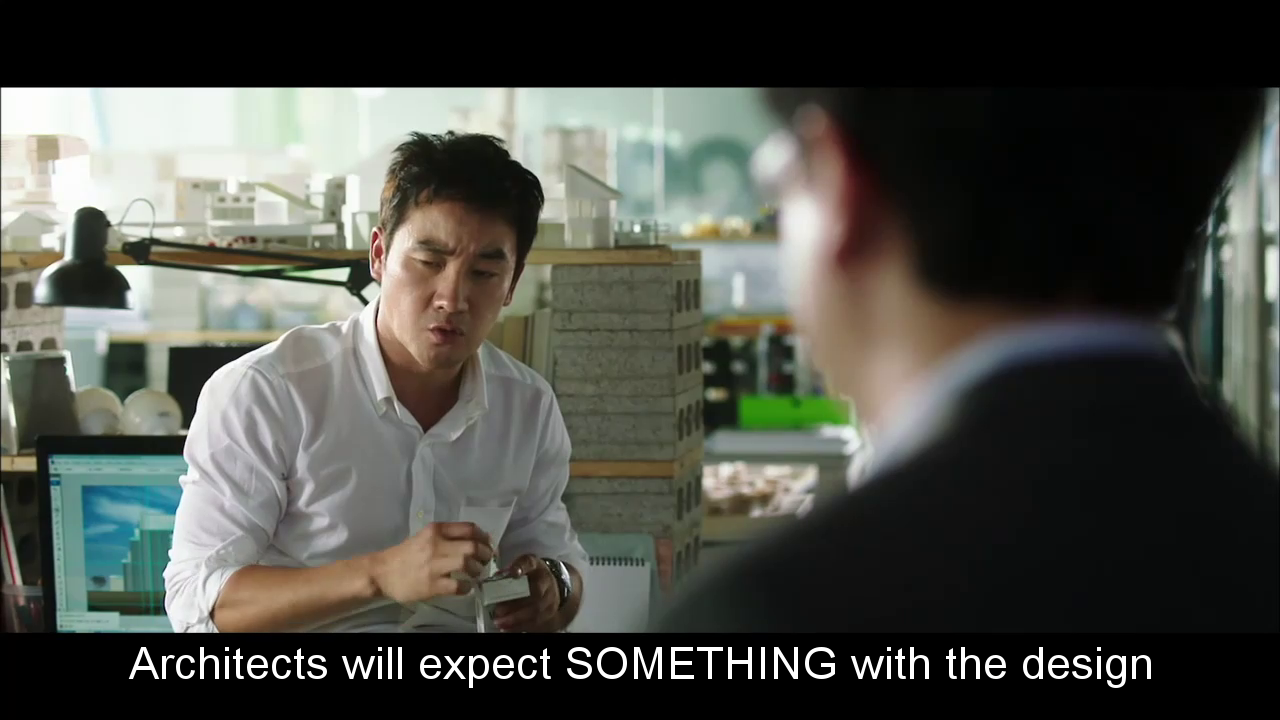
Yesterday, my girlfriend and I embarked on a pretty ambitious summer project: to make English subtitles for the movie, Architecture 101. I know that I could easily just download an SRT file somewhere, and even if it's out of sync, it wouldn't be too hard to match up the time settings because I understand both languages. But the point is not to actually have the subtitles; it's to make them.

Subs Factory: The program that I use to create subtitles

In the past, I used to try to subtitle various Korean TV shows as an exercise to not only improve my Korean vocabulary, but also to try to explore the almost-inexpressible subtleties between the Korean and English languages. The never-ending struggle in subtitling (and translation in general) is to strike that balance between faithfulness to the original dialogue/text and natural speech in the translated language. If you make too direct a translation, then the result will be awkward, stilted, and possibly comical. But if you take too many liberties, you may actually end up significantly altering the source material.

An example of a Korean word that I find very difficult to translate is "놈", which is pronounced "nom" (with the "o" sounding like "Ohm", except not drawn out). It's kind of a swear word, but it's also not. If you say it to a stranger, you'll probably start a fight. But friends use it with each other to just joke around, as do parents with their children. What's the English equivalent? Maybe "bastard"? But if you put that in subtitles, it can look extremely harsh, especially when you have a father character saying it to his kid.

Our very own artisanal handcrafted subtitles!

In fact, some of the hardest stuff to translate happens when parents talk to their kids. For example, there are lots of half-cute/half-chastizing words in Korean that a parent can use when his/her kid does something stupid. But if you translate that into English, they tend to come out as "Idiot", "Fool", "Dumbass", etc. It ends up sounding very cruel and abusive when it's not.

When I make subtitles, I also realize how much is irretrievably lost in translation. That saddens me because that means no matter how well a French, Chinese, or Turkish movie is subtitled, I am probably losing at least about 50% of what makes the movie good. Even if I were somehow to magically become fluent in the relevant language, I would probably miss out on all the cultural stuff that you can only get from growing up in that culture. I mean, I grew up in a Korean household with immigrant parents who always spoke to me in Korean, and I understand most stuff in TV shows and movies, but I'm still not in tune with the culture-specific stuff because. For example, I never went through the Korean school system, served (or had to think about serving) in the military, etc.

Like when I was watching Answer Me 1997, I wasn't able to directly relate to the epic H.O.T. vs. g.o.d. fanwars that ensued in the 1990s. And I'll never be able to. Sadness.


Anyway, the program I use is called Subs Factory, and it's free to download. The only bothersome thing about it is that it can only play MP4 videos, I think. Therefore, if you have files like AVIs and MKVs, you'll need to download/buy a video file converter to change them to MP4s.


Thursday, June 20, 2013

Makgeolli will be the next big thing

Chestnut-infused makgeolli from Moon Jar
Soju is sort of gaining some notoriety outside of Korea, but I don't think most non-Koreans know what makgeolli is. Still, I do know that some of my non-Korean friends in New York City really enjoy the stuff (I'm looking at you, AK, if you're reading this), though it still pains me to have to pay $20 for a bottle of makgeolli that I could get for about $2 at a Family Mart here. I have nothing against soju, but it's just a weaker and sweeter version of vodka, which itself is a boring liquor that seems to come out with 10 pointless gimmicks every year. There's nothing quite like makgeolli on the other hand, especially the freshly brewed kind.

I had my first taste of makgeolli (Korean rice wine) when I went to Andong a few years ago. It had been a really hot summer day and my relatives had been showing us around the many temples and villages in the area. Needless to say, we were all sweaty, sticky, tired, and just beaten down.

At night, we sat outside to eat a dinner with all the classic Korean staples, most of which I had grown up eating. But there was one thing that was quite unfamiliar to me, and it was in a moderately-sized clay pot. It was a liquid, whitish and creamy in colour. At first glance, it looked like skim milk.

I'll never forget that first taste, though I don't quite remember what the exact sensations were. All I remember was that it was cool, smooth, and a little sweet. Best of all, after a few bowls (yes, they were served in little bowls and not cups), you felt a little buzz that just made everything better.

When most people think of Korean liquor, they think of soju. Some people love it, some people hate it. I'm pretty neutral about it. All I know is that my worst drunkenness tends to happen when I drink soju because I lose track of how much I drink. In America, I measure everything in terms of a single shot of 80-proof liquor. Soju is only 20% ABV, and you drink it throughout your meal, so my whole counting system goes haywire. It's as if I'm used to measuring in the metric system and I find myself using imperial units.

And then by the end of the night, I'm getting into confrontations with cab drivers after I kick their vehicles when they refuse to drive us home...

Anyway, back to makgeolli! It's a great drink, but the bottled kind that they sell on the cheap has that carbonated, Spritey taste that I don't like. For the really good stuff, you should go to a bar that makes fresh makgeolli. It won't cost you THAT much more than the bottled stuff, and it's so worth it.

I've only been to a couple of establishments that make their own makgeolli. Here they are:

Wolhyang

My brother and me, enjoying makgeolli, boiled potatoes,
and kimchi
Wolhyang is located in Hongdae, and it's famous for its brown rice makgeolli that's almost as strong as soju. Just keep that in mind as you down bowl after bowl of this supposedly harmless drink.


Moon Jar

Another famous makgeolli joint, this one is in Apgujeong in the Rodeo area. The interior has a very worn-down feel that I think is supposed you remind you that makgeolli is a farmer's drink. I need to go back here many times to try all their different variations.


UA-49948643-1